.jpg)
The Gear We Require Our Guides to Carry

And the stuff we strongly recommend, even though we don't make them buy it.
Every guide who works for us carries their own kit. Not because we're cheap, but because gear you own is gear you take care of, and gear you take care of works when you need it.
Most of this list is small and cheap. A few pieces of it are the difference between a story and an incident.
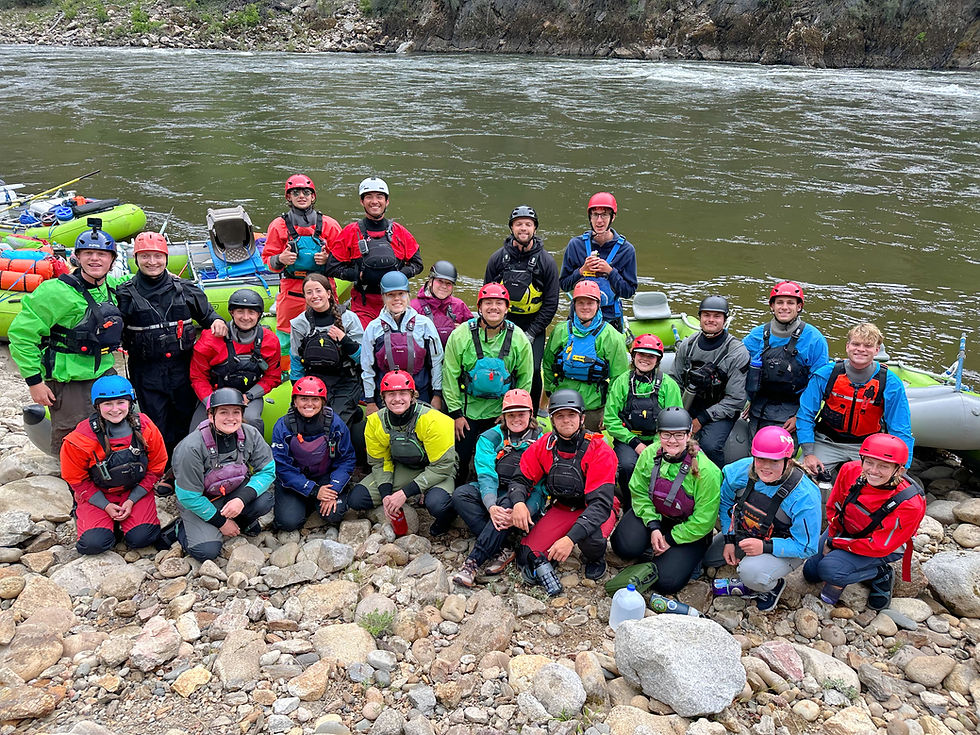
People ask us what a working river guide actually carries, whether they're thinking about guiding, building their own kit for private trips, or just curious what's in the pocket of that vest. So here's the whole list, what we require, what we only recommend, and the reasoning behind each one.
Required
PFD
A whitewater PFD with a rescue knife holder and a pocket. Not a water ski vest, not a fishing vest, not the orange thing from the marina.
What we tell people to look at:
NRS Ninja - the most affordable option that's actually right. No rescue belt.
NRS Ninja Pro - same vest with a rescue belt added. Best value in the lineup.
Astral Greenjacket, Astral Indus, or the Kokatat Hustler - higher end rescue vests. Worth it if you're planning to go further with guiding or kayaking.
We want newer PFDs on our guides. Astral recommends replacing a vest every five years or 300 days of use, and for a working guide 300 days comes fast.
Foam PFDs do lose flotation, and it's worth understanding why, because it isn't mysterious. The foam takes a permanent compression set from years of being cinched down, stuffed into dry bags, sat on, and stacked in a boathouse. It absorbs water. Heat and sun break down the foam and the shell.
The part people miss is that the vest usually fails somewhere other than the foam. UV eats webbing and buckles. Stitching gives up. And a USCG label that's worn illegible makes a PFD legally non-serviceable no matter how good the foam is, which is the single most common way a five-year-old fleet vest gets retired.
Squeeze the foam. If it's hard or waterlogged instead of springy, it's done.
On rescue PFDs, specifically
We strongly recommend one. We do not require one.
That sounds backwards for a company that pushes hard on rescue training, so here's the reasoning. The quick-release belt gets used rarely, it requires real training to use safely, and worn or rigged wrong it becomes an entrapment hazard instead of a rescue tool.
We're not alone on this. American Whitewater's safety code calls tethered rescue "a high-risk technique that should only be attempted after formal training." NRS published an article called "Rescue PFDs Aren't For Everyone" that says the harness "is NOT foolproof" and that "used incorrectly, it can jam and put the user in a dangerous spot."
Most of our summer guides end up buying one anyway, and we're glad they do. But we'd rather someone wear a vest they understand than a belt they don't.
River knife
Mandatory. Every guide, every trip.
The NRS Co-Pilot is our default. Don't buy the Pilot. It's too big for the job and it gets in the way. The Bear Claw is also a good knife if you want to spend more.
It mounts on the outside of the PFD with a quick release. If you're working around rope, you carry a knife. That's the whole rule.
Secondary knife
Also required. A small, cheap folding knife that lives inside the PFD pocket.
The reason is simple: river knives sink during rescues. They come out of the sheath, they get knocked loose, they end up on the bottom of the river. The backup is the one that's still there when the first one is gone.
This is the cheapest item on the list and it's the one we'd least want a guide to be without. Ten dollars, in a pocket, forgotten about until the day it matters.
Whistle
A Fox 40. Loud, lasts forever, costs a few dollars.
Also, it's the law in Idaho. You need a sound-producing device on the water.
Helmet
Required during high water, any time you're kayaking, and any time you're guiding Scouts.
You can use ours until you're ready to buy. The WRSI helmets through NRS is a great deal in the category.
Frame tool
An NRS frame wrench. Order it early.
Our past guides have been emphatic about this one, and they're right. This is the tool you want when an oar tower or an oar sleeve gets knocked loose in the middle of a rapid. It weighs nothing and it turns a trip-ending problem into a two-minute fix.
Flip line
Ten feet. This one works well.
You carry it in your PFD, not around your waist, and not dangling. It's for getting a boat back over.
Locking carabiners, auto-locking
One or two. Around 22kN is the sweet spot: strong enough for anything you'll do with it, not so big and heavy that you stop carrying it. The NRS SLIQ triple lock is a good deal.
Auto-locking only. We all love carabiners and we use them constantly for rope work and rescue, but an exposed non-locking biner is a trap underwater. It doesn't care what it clips to. Bring them, but lock them or pack them away.
CPR mask
Carried in your PFD, not in the first aid kit on the boat.
We usually provide small masks in guide training. The reason it lives on your body is unglamorous: near-drownings involve vomit and foam, and you do not want to be making that decision without a barrier in your hand.
Radio
New requirement for 2027.
We tested these last season and most of our team bought their own by the end of the summer, which told us everything we needed to know. They're going in the required column going forward.
We use them for guide training, high water, all guides with big groups, the store and office, and day trip drivers.
We run the Rocky Talkie Expedition. It's the one in their lineup that's actually IP67 waterproof, the battery holds up over multiple days, and the belt clip doesn't break the first time it catches on a frame. Get the locking carabiner option. A non-locking carabiner on a PFD is a trap, which is a theme you'll notice running through this whole list.
Cheaper waterproof radios exist and they mostly disappoint. Short battery life, weak clips that break and send the radio to the bottom of the river, and not enough range to reach anybody once you're down in a canyon.
Dry bag
We have plenty, but having your own is better. Watershed or an NRS Bill's Bag. Watershed is the most waterproof and the easiest to seal.
River shoes
Sandals work and Chacos are a classic for a reason, but our most experienced guides mostly don't wear them.
We see a lot of toe injuries. Closed-toe water shoes like Astral or Five Ten Trailcross make a real difference, and they cut down on the foot rot and endless sunburns that come with wearing sandals for ninety straight days.
Pro tip from the crew: wear slow-drying shoes that stay wet through the day, then switch to dry shoes and socks at camp. That's the best defense against cracked, rotting feet.
If you're running a drysuit with wool socks and neoprene socks, size up one to one and a half.
Neoprene socks
Mandatory for April and May training, preferred until mid-June. Cheap on Amazon, and they turn any shoe into a warm-water shoe.
For ten or fifteen dollars this is probably the highest return item on the entire list.
The advanced kit
Required for lead guides and for anyone working the Middle Fork or Murtaugh. Strongly recommended for everybody else.
Most of our guides end up carrying this whether we require it or not, and the ones who do tend to be the ones who get asked to lead.
Prusik loop
6mm, carried in your PFD with your second carabiner.
6mm is the in-between size, and that's the point. It grips well on throw rope, and it also holds on the larger static lines you'd rig z-rigs with. Go thinner and it's too weak. Go thicker and it slips on throw ropes. One loop that works on both is worth more than a perfect loop for one of them.
You can buy a pre-sewn loop, or buy four feet of 6mm cord from NRS and tie your own. Tying your own is better practice anyway.
Pulley
A small pulley for mechanical advantage.
A prusik, two locking carabiners, and a pulley in your PFD is a Z-drag you're carrying on your body. Get two or three guides on a scene who all carry it and you've got serious hardware on site in seconds, with nobody swimming back to a boat to go find it. That's the entire reason for this section.
Cold water gear
If you're doing early season training or high water events, this stops being optional.
Wetsuit or drysuit. We have wetsuits you can check out, but bring your own cold water gear if you have it. May and early June are high and cold and it's required.
Neoprene socks or booties. Same ten dollars, same enormous difference.
Thick wool or fleece leggings. You need to dress genuinely warm under a drysuit. People underestimate this constantly.
Puffy jacket and warm fleece or wool layers.
Optional, but our guides swear by it
Sun hoodie. Not required. Will change your life.
GoPro. Guests love it, sharing video makes tips, and it pays for itself.
Guitar or ukulele. If you play, this adds more to a multi-day trip than any piece of gear on this list. Bring a hard case and don't bring your nice one.
Small dry box or ammo can for the things you need during the day.
Waterproof Bluetooth speaker.
Diving mask, snorkel, and fins. Once the water drops and warms up, diving the river is a genuinely great way to spend an afternoon. We find some crazy stuff.
On buying all this
An Idaho guide license is a ticket to 30 to 60 percent off with almost every outdoor company in the country.
Buy your own, take care of it, and it'll last you years past this season.


Comments