.jpg)
Discovery of the First Petroglyphs on the Middle Fork

Updated: Feb 2
How the Site Was Discovered
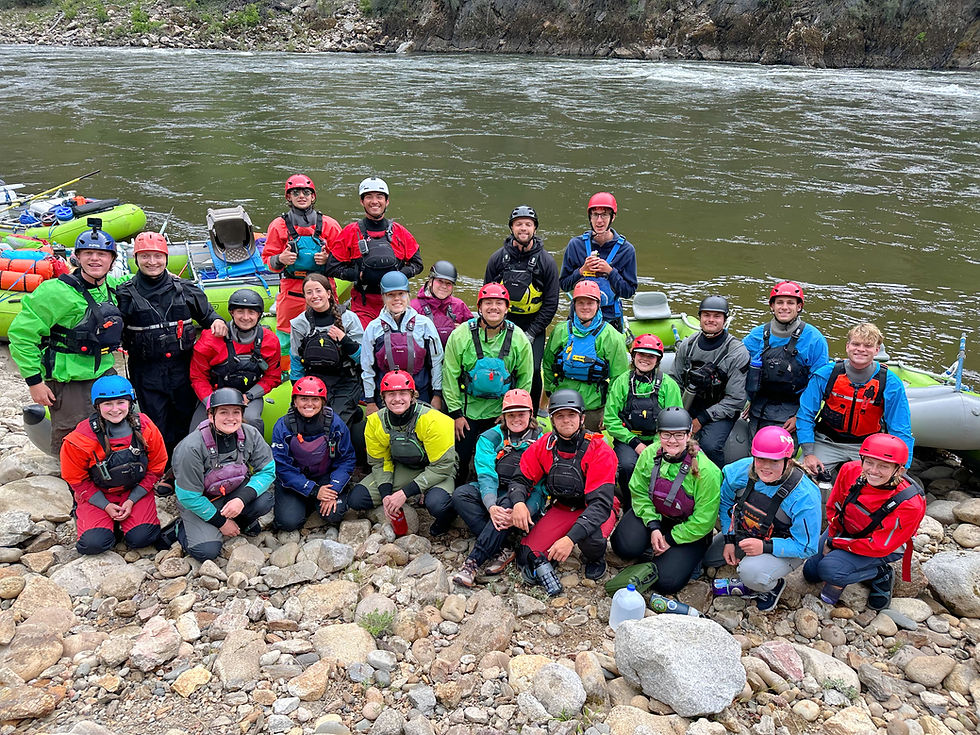
This happened on a commercial Middle Fork trip in 2018, while I was guiding for Middle Fork Adventures.
We landed at camp and moved into a normal evening. Boats tied up. Dinner prep. People settling in.
A college-aged young man on the trip asked if he could cross the river and go for a hike. We talked through the plan and he paddled an inflatable kayak across.
What stood out was where he went.
This camp had obvious trails and commonly explored areas. He ignored those and instead bushwhacked and scrambled up a steeper, less traveled section of hillside.
About an hour later he returned.
He told me he had found Indian writing.
I told him there is a lot of Native writing along this river, but I was interested. This was not a site I knew about. Then he added the detail that changed everything. He said the markings were carved into the rock, not painted.
That stopped the conversation.
We crossed the river.
Time on the River and Context
I have spent a good portion of my life on the Middle Fork.
I guided multiple seasons with Boy Scout crews, dozens of private trips, and later guided for other outfitters.
Over the years, that adds up.
I have now completed 52 Middle Fork trips.
That time matters. It means seeing the canyon in different conditions, different years, and different states of mind. It also explains my relationship with Diana Yupe, who plays a central role in this story.
Native History of the Middle Fork
The Middle Fork Salmon River corridor was historically home to the Tukudika, also known as the Sheepeaters, a band of the Northern Shoshone.
They lived here traditionally, hunting, fishing, and gathering with a deep relationship to the river and the salmon that sustained them.
This was not ancient history.
Traditional life in this canyon continued until 1879, during the Sheepeater War, the last Native American war fought in the Pacific Northwest. That effectively ended Native people living freely off the land.
That date matters.
Not thousands of years ago.
Not hundreds.
Roughly 145 years ago.
People lived here within recorded history. Their descendants are still alive today. The carvings and paintings in this canyon are not abstract relics. They are the marks of people whose lives overlapped with modern America.
The Site
As we scrambled up the hillside, I observed the topography. From a practical standpoint, this was one of the best hunting ambush locations I have seen anywhere in the Middle Fork canyon.
The terrain explains it immediately.
A narrow choke point. Large boulders positioned perfectly for concealment. A steep cliff above. A ledge with visible game trails. Steep brushy terrain below that funnels animals upward and toward this spot.
One person could hide behind a boulder with a spear. Two or three others could push game from upstream or downstream. Everything would converge here.
It is easy to imagine someone waiting for long stretches of time and carving into the rock to pass the hours. Disclaimer: I am not an archaeologist or a formal expert on rock art or cultural sites. Everything here is based on firsthand experience and conversations with knowledgeable sources. If others have more complete information or corrections, I welcome it.
The Rock Itself
Most of the Middle Fork canyon is granite. It is chunky and granular and does not hold fine detail well.

This site is different.
A dark rock intrusion cuts through the granite cliff. It has a slate-like texture and appearance. Smoother and denser than surrounding rock. Far better suited for carving.
If carvings were going to exist in this section of canyon, this surface explains how and why.
Diana Yupe
Diana Yupe was Shoshone.
For many years, she spent several weeks each summer at Indian Creek, a well-known stop along the Middle Fork. There, she gave interpretive talks to river groups. She explained the people who lived here, their relationship to the salmon, and how the river shaped their lives.
She often ended her talks with a Native blessing for safe passage through the rough water downstream.
People always asked her the same question.
What do the pictographs mean?
She explained that when a young person came of age, they would go out on a vision quest, fasting and praying until they received a vision of their purpose in life.

Many of the pictographs along the river depict animals. Bighorn sheep. Deer. Elk. Bears.
We would sometimes joke quietly that after fasting long enough, a young man’s vision often confirmed his purpose was to hunt, kill, and eat.
It was a gentle way of acknowledging both the spiritual depth and the practical reality of survival in this canyon.
Over decades, Diana documented and helped preserve many Native sites along the Salmon River. Early on, that work was not welcomed. Later in life, her efforts were recognized and she was given tribal honors for preserving the heritage and history of her people.
She passed away in recent years.
Talking With Diana About the Discovery
After we found the petroglyphs, I discussed the site with Diana.
Her initial response was firm. She said there were no carvings in the canyon, only paintings — pictographs, not petroglyphs — meaning images painted on rock rather than carved symbols.
Instead of arguing, I drew the symbols in the sand exactly as we had seen them.
She paused.
Then she confirmed that one of the symbols was a known tribal identifier, a symbol associated with this specific people.
That mattered. Not because it answered every question, but because it confirmed this site was likely connected the people that lived here previously.
The Carvings
Carving One

This carving was clearer and more defined when first discovered.
The photo shown here was taken a year later in 2019. By then, word had spread. The surface was dusty, and greasy fingers had clearly been run along it.
Oils and dirt degrade these sites quickly.
This carving is the tribal identifier Diana confirmed.
Do not touch rock art. Observation is enough.
Carving Two

This symbol appears similar to Native American rock art found across the American West.
This may resemble a dreamcatcher symbol, though interpretations vary. It fits within a broader symbolic theme seen throughout the region.
Carving Three

This carving is different.
The others are etched deeper, as if pounded into the stone. This one is lightly scratched on the surface.
It could be more recent. It could be someone experimenting with a basic tool. It could be initials from a later visitor. It could also be older than it appears.
It almost resembles English characters but is simple enough to mislead.
No conclusion is drawn.
Other Sites, Promises, and Restraint
Diana and I discussed many other locations in the canyon.
Pictograph sites. Burial grounds. Artifacts. Places rarely visited and that she intentionally chose to leave undocumented.
Out of respect for her people and a promise I made, I will not reveal these locations. Everything shared here reflects the extent of those conversations. Locations remain protected and preserved.
Over the years, we have encountered dozens of other pictograph sites, many not formally documented, scattered throughout the river corridor.
One site in particular stands out. At an overlook, there is a rock formation resembling an altar. Surrounding it are numerous pictographs with heavy red pigment. On the side of the rock is a knife- or dagger-shaped image painted in red, consistent with what appears to be a ceremonial or altar-associated site.
Photos were taken initially and later deleted.
That decision was deliberate.
Some places don't need to be documented or circulated.

Arrowheads have also been found along the river corridor. When encountered, they were left exactly where they were found. Larger artifacts have been encountered in recent years. In many cases they were left in place, only to later disappear as word spread.
Observation is acceptable. Removal is not.
Update After Publication
After publishing this article, another Middle Fork guide reached out to me.
He shared that he had been investigating these same petroglyphs around the same time and had also spoken with Diana Yupe about them. His conversations with her were similar in tone and content to mine.
He also relayed something he had heard years earlier: that a former Forest Service river ranger, Rick Piva, may have carved some of the markings in the 1990s.
I want to be clear. I have no direct evidence to support that claim, and I find it difficult to believe that a Forest Service employee and river ranger would intentionally carve symbols into rock in the canyon. That statement remains unverified and secondhand.
However, it is part of the broader story and worth acknowledging.
Additional Observations
Reflecting further on the carvings, there are aspects worth noting.
Carving Two, in particular, appears to have been made with something round. The marks have a consistent curvature. I am not ruling out that Native people could have created it, but it would have required a tool harder than the rock itself. The roundness of the impressions could suggest the use of a small, rounded chisel or tool.
Carving One still holds the strongest potential connection to the tribal identifier Diana recognized. That symbol is what initially caught her attention and led to a meaningful pause in our conversation. Combined with the location — an exceptional hunting ambush site — it remains compelling.
What We May Never Know
This article may be the only documentation of this site and these conversations.
It feels important to state these points clearly, even where certainty is not possible. Some details may never be confirmed. Some origins may remain unknown.
That uncertainty does not diminish the significance of the place.
The site remains an extraordinary location, both geographically and historically. Whether parts of the story are ancient, recent, or a mixture of both, it stands as a reminder that the canyon still holds layers of human presence we do not fully understand.
And we may never.
Conclusion
One purpose of this article is to document that these conversations happened. That these places exist. That there is more in this canyon than what is commonly known or mapped.
There is still more to be found.
Some sites remain undiscovered. Others are known only to a few. Some we will never fully understand.
That is part of what makes the Middle Fork special. Preserving the opportunity for adventure and discovery for future generations.
Not everything needs to be explained.
Not everything has to be shared.
No Luck in the River Permit Lottery?
We offer rentals and row-your-own trips on the Main Salmon and Lower Salmon.
Middle Fork rentals and delivery are available.
Row-your-own trips are not offered on Scout Middle Fork trips. View Rentals View Row Your Own Trips
There is still adventure and discovery waiting to be found on the river.


Comments