.jpg)
We Rent Rafts. These Are the Safety Mistakes We See Most.

Ranked by how hard it is to get free, not by how often we see it.
We rent boats all over Idaho. Day trips, multi-days, paddle boats and gear boats.
Every one of them comes back. And when it does, somebody on our crew goes over it with a checklist before it goes out again.
Which means we see a lot of rigging we didn't do.
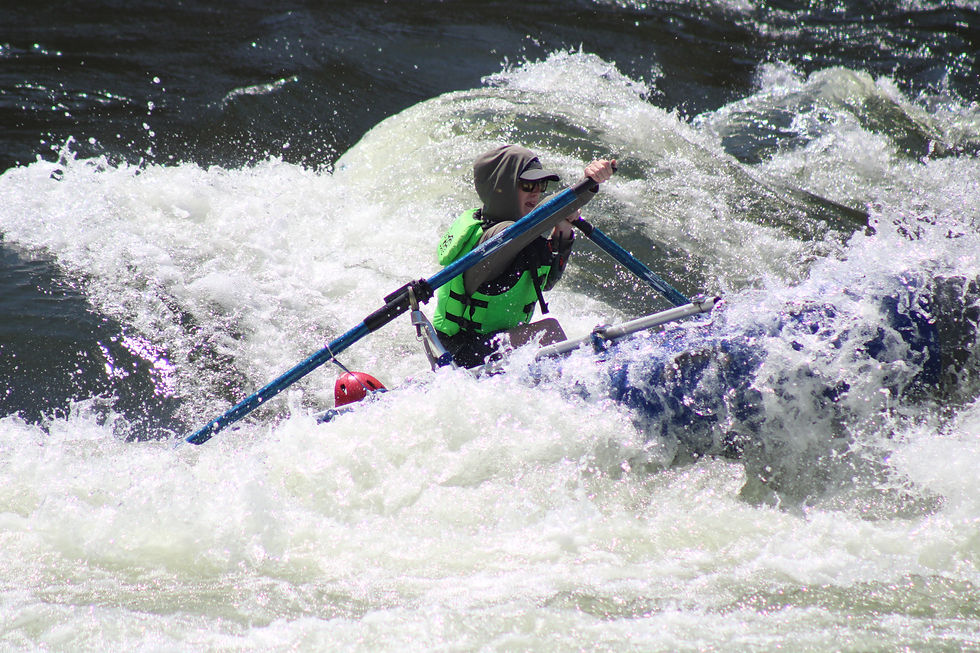
Most of it is fine. Some of it is genuinely good, and we've picked up things from renters running tighter systems than ours. But a handful of problems come back over and over, and a few of them are the kind that don't give you a second chance.
Before I start, because I'm an outfitter manager writing about other people's boats and I know exactly how that reads: we've had our own flips. We've had wraps. Anybody who runs enough trips has. This isn't a list of things other people do and we don't.
How I ranked these
By how hard it is to get free, not by how often we see it.
Because almost everything here is the same mistake wearing different clothes. Something added to the boat that can catch a person.
American Whitewater's safety code puts it in one sentence:
"Outfit your boat to ensure that nothing will cause entrapment or entanglement when coming free of an upset craft."
Every item below is a way of not doing that.
1. Bow lines that aren't stowed
I know of a fatality on the Middle Fork that came down to a bow line that wasn't stowed.
That's why this one is first.
A bow line needs to be stowed so that it has no loops and no way to come undone on its own. What comes back on our boats instead: knotted messes in the floor, line woven through the frame, coils that will pay right out the second the boat goes over.
Guides call a loose bow line the death snake. That's shop talk, not a technical term, but it's the right picture. Rope in moving water finds people.
So we took most of them off our rental boats.
That's our call, not an industry standard. Nobody else I know of does it, and no safety organization recommends it. If I can't control how it gets stowed, I'd rather it not be on the boat at all. On our commercial fleet, we drill our guides on properly stowing bowlines.
What we run instead on rentals, the throw bag can also be used as the bow line. It does the same job, and people treat a throw bag with more respect than they treat a loose coil of rope.
If you're keeping yours, and most private boaters should:
Keep it short enough to be useful and no longer. Long lines are for lining boats, not for sitting on the bow all day.
Coil it tight, starting a few feet off the boat, and strap the coil down with a quick-release bight you can pop with one hand.
It should be impossible for it to deploy on its own in a flip. If you can shake it loose standing on the beach, the river can.
2. Biminis (Shade Covers) left up in whitewater
I want to be careful here, because I understand the appeal completely. The sun is brutal and shade changes the whole day.
We don't run them and we won't rent them. But that's our operation, and plenty of people who know what they're doing use one.
Some of our crew dive for lost gear at boat ramps. Just out of sight, in the deeper water below a lot of ramps, there's a graveyard of shade covers and umbrellas that the wind got.
That part is just money. Annoying, expensive, and nobody gets hurt.
Here's the part that bothers me. We see people rowing with them up through Class III and IV. Not occasionally. Regularly, in the same rapids where we watch private boats flip day after day.
And the people selling them already said not to.
4Corners Riversports, on the Coyote Raft Bimini, which is the only bimini actually built for whitewater rafts:
"We highly discourage rowing whitewater above Class I-II with the bimini deployed."
Their own assembly guide says to collapse it "in heavy winds and through any rapid where a flip is even the slightest possibility."
Class I to II. That's the seller's number, not mine.
Here's the strange part. The exact same product, listed at another dealer, carries no whitewater guidance at all. Just a chemical warning. Same bimini, two shops, two completely different ideas of what you should be told.
A frame builder, Eddyline Welding, has already written down the mechanism I worry about:
"A bimini just folded down on a raft frame can still make for some entrapment hazards."
They warn about something getting "between the bimini bars and the frame." That's a person, upside down, in the dark, under a boat, in a structure of aluminum tubing and fabric and webbing. Add the non-locking carabiners and hooks we see people using to hang them, which is item five.
Now the honest part. I could not find a single documented incident involving a bimini on a whitewater raft. No flip, no entrapment, no injury, anywhere.
Nobody has written about this at all. Not American Whitewater, not the ACA, not Rescue 3, not a guide school, not another outfitter. The AW safety code doesn't contain the word canopy.
That's an absence of record, not evidence of safety. These went mainstream around five years ago and private near-misses don't get reported to anybody. But I'm not going to pretend there's a body of evidence when there isn't one.
Put it down before the rapid. The company that built it says the same thing.
3. Knots tied in throw bag ropes
Almost every throw bag we get back has a knot in the working end. Some bags still ship that way.
We take them out. Four reasons, and the first one is the one nobody talks about.
The knot tells people where to grab. They grab the very end, because that's where the knot is. Now there's no slack and no give, and when the rope comes tight they either get pulled into the river or they let go. Neither one helps the swimmer.
A knot dragging through rocks acts like a clam cleat. If the rope gets yanked out of somebody's hands, and it will, you now have a swimmer headed downstream with coils and a knot trailing behind. Two rocks pinched together work exactly like the cleat on a sailboat. The knot goes in easy and it does not come back out.
I've had to cut ropes I couldn't recover. Caught in rocks, underwater, mid-rapid. The knotted end never came back.
And a knot plus a clipped bag makes more loops, not less. When the knot is clipped on the outside of the bag and you flip, violent water can pull rope out of the bag while one end stays clipped. Now there are loops in the water instead of a rope in a bag.
The objection I always get is fair: how do you know where the end is?
Undo the knot and drop the entire rope inside the bag. When you go to throw, pull out a handful and drop it. That's what I was taught in swiftwater rescue and it's what we teach. It works better than people expect it to.
I'll say plainly that this is contested. Ask ten guides and six or seven will tell you they like the knot, and some rescue instructors won't take a side at all. Their reasoning isn't stupid either, mostly that cold hands lose a clean rope.
From what we see coming back, and from the ropes I've had to cut, this is what works best for us.
American Whitewater's older code was blunter than I am:
"Do not knot the end of a rope, as it can get caught in cracks between rocks."
The 2024 rewrite softened that to "avoid tying knots and loops into ropes." Take that for whatever it's worth.
4. Cargo nets
We get asked for these constantly. The answer is no.
I'll be upfront that this one is my reasoning, not established doctrine. No safety organization has published a position on cargo nets. The American Whitewater safety code does not contain the word net.
But the rule everybody agrees on is that a loop big enough to put a hand through is a hazard. And a cargo net is, by construction, a grid of exactly that.
Under tension they grab. PFD buckles, sandal buckles, the tail end of a strap. And a net over a tidy load right side up is a different object than a net hanging off an upside-down gear boat with somebody underneath it.
Use cam straps. Run them through gear rather than over it, strap items individually where you can, and daisy-chain the tails. Nothing hanging longer than your palm.
5. Non-locking carabiners
Short one, because there's already good writing on this and I don't need to add to it.
American Whitewater, 2024:
"Non-locking carabiners and hook-shaped hardware can incidentally clip onto you or your equipment."
We see them on PFDs. We see them holding water bottles off the side of the boat. We see them in various rigging setups.
There's videos on youtube of what happens when one of these finds a PFD strap at the wrong moment. Go watch it.
Locking only. And actually locked. Auto locking is preferable.
6. Helmets, and the hat problem
I'll concede the hard part first. It is difficult, maybe impossible, to keep people in helmets on a long hot multi-day. I'm not going to pretend we've solved that.
What we see is hats.
Here's my argument, and it isn't about class ratings.
Boats flip everywhere. Not just in the rapids you'd expect. We've watched boats hit rocks in Class II and roll. Fast flat water, one bump, and somebody's in the river. Sometimes hitting a rock on the way out. Our guides come back with reports of pulling private boaters out of places nobody would have guessed, wrapped in spots you'd never look at twice from a boat.
Class II does not mean safe. It means easy to run, which is a completely different sentence.
You can't schedule the flip. That's the whole problem. If you could, everybody would wear a helmet for the rapid and take it off after, and none of this would matter.
Worth knowing that the published guidance here is a mess. American Whitewater calls helmets essential for kayaks but only recommends them for rafters "running steep drops," with no class threshold. Dinosaur National Monument requires them for kayaks and paddleboards and explicitly exempts rafts. Grand Canyon, the BLM's Lower Salmon guide, and Idaho itself have no requirement at all. Scouting America is the outlier and requires them at Class II and up.
So there's no standard to point at. This one is my opinion, and my opinion is that the flip you're wearing it for is the one you didn't see coming.
7. Nobody practices swimming
This one isn't rigging, and it's the item I'm least comfortable saying, because it sounds like criticism of people's fitness. It isn't.
Almost nobody in the whitewater community, including plenty of professional guides, has actually practiced swimming rapids. It's a skill and it gets treated like a reflex.
The tell is simple. If you come out of a rapid gassed, you did it wrong.
Swimming whitewater well is mostly about not fighting. Relaxing your body, timing your breathing to the troughs instead of the crests, reading the river the same way you read it from the boat, and conserving everything you have until there's a specific reason to spend it. Then sprinting hard, once, because that eddy is the one you're getting.
People who haven't practiced do the opposite. They tense up, swim the whole way, at full effort, from the moment they hit the water. Then they arrive at the part that actually required effort with nothing left.
We wrote a whole piece on how to swim a rapid, so I won't repeat it here. But the short version is that this is trainable and almost nobody trains it.
8. Food systems that eat the trip
Ending on the one that probably won't hurt anybody, because it might be the one that ruins the most trips.
The stress we see on the private side is almost never the whitewater. It's food. Who was supposed to bring what. Whose cooler that was. Why there are four bags of tortillas and no eggs. We've watched groups spend a week irritated with each other over a system nobody actually owned.
It's a solvable problem and it's worth solving before you launch, not at the ramp.
TripForge, who we partner with for rentals, has meal planning and trip logistics built in, and we point rental customers there for exactly this.

What good looks like
Short version, if you skipped to the bottom:
Nothing on the boat forms a loop big enough for a hand.
Every line is stowed so it cannot deploy on its own.
Strap tails daisy-chained, nothing hanging longer than your palm.
Locking carabiners, locked.
Throw bag rope stuffed loose inside the bag, no knot, bag accessible.
Shade comes down before the rapid.
Everybody knows what they're supposed to eat on day four.
One more thing
Plenty of people want to run their own trip, and we're completely for that. Some of the best-run operations we see on these rivers are private groups who take it seriously, and we've learned things from them.
We also see people who drew a permit and would have had a better week on a commercial trip. Smoother, more compliant with the regulations, safer, and less arguing at camp.
Both of those are true at the same time, and there's no shame in either one.
Whether you want a full setup, a couple pieces of gear, a Row Your Own trip where we handle the logistics and follow you down, or a fully guided trip, we do all of it. Next up: Aug 31 Row Your Own - 4 Days on the Lower Salmon Learn More


Comments